In Bangladesh’s ready-made garment (RMG) sector, change isn’t just on the horizon, it’s already unfolding. As automation, digitalisation and climate risks reshape the future of work, women garment workers, who make up the majority of the workforce, are facing increasing uncertainty.
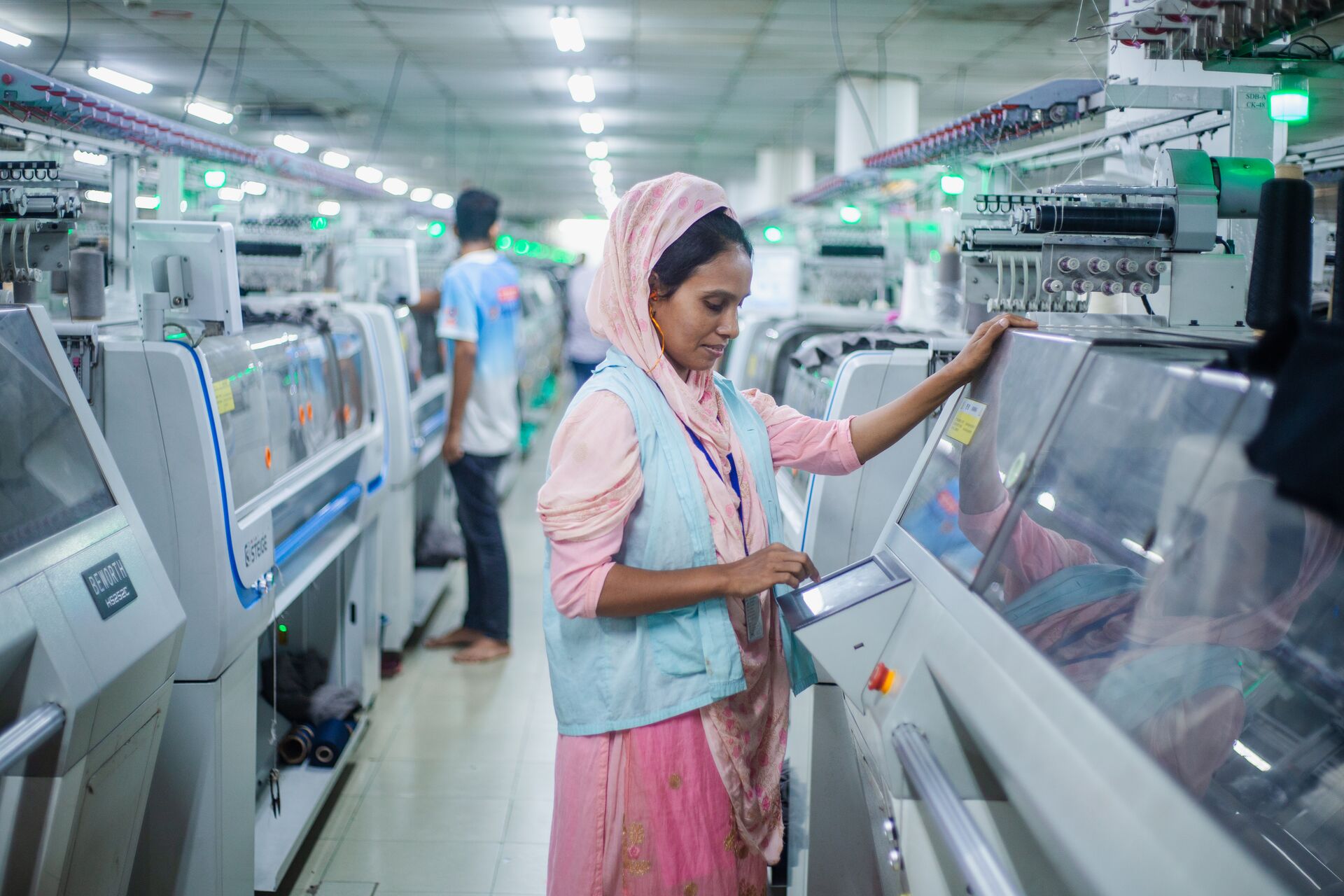
Mousumi and one of her colleagues working in Zirabo, Savar, Dhaka. Photo credit: Oporajita.
With this as a backdrop, we launched Oporajita in 2022, a first-of-its-kind Collective Impact initiative that brought together 14 diverse organisations, from government bodies and NGOs to startups and UN agencies – to equip women garment workers with the skills, networks and resilience needed to thrive in a changing industry. As of March 2025, Oporajita has supported more than 80,000 garment workers.
What we did and what we learned
Now, as we enter Phase 2 (2025–2027), we’re bringing successes, new lessons, deeper partnerships and stronger ambitions to the table. While there’s still a lot of work to be done, the following highlights offer a snapshot of what’s been achieved – and what we’ll continue to build on.
Improved job opportunities and professional growth Oporajita has played a pivotal role in equipping women with the skills to grow in their careers and step into leadership roles. Circular economy training has also opened up new pathways to employment, with many women securing jobs and increasing their incomes as a result. The initiative has championed entrepreneurship among women garment workers – especially those out of work, and has also sparked industry innovation by backing scalable startups that put people and planet at the core.
Shifting perceptions and raising voices By amplifying voices of women workers and bringing attention to critical labour and social issues through large digital campaigns and public outreach, we’ve helped broaden understanding of gender equality in the RMG sector and encouraged more open dialogue across different parts of society. These efforts have helped to reposition women workers not as passive recipients of support, but as active agents of change.
Better conditions in workplaces and communities A key part of Oporajita’s approach has been to support women garment workers not just through skills and jobs, but by working to improve the conditions that shape their daily lives. The initiative for example contributed to better access to services such as psychosocial and health support, hygiene facilities and education and well-being for workers’ families. By addressing challenges at both factory and community level, Oporajita has helped lay the groundwork for more lasting change.
Learning as we go
Aiming to transform current systems is rarely straightforward – and Oporajita has been no exception. The initiative was shaped by a volatile context, from the aftermath of COVID-19 to labour protests and political unrest.
These disruptions affected planning and delivery, often requiring partners to rethink and adjust their work at short notice. In some cases, access to factories was delayed, slowing down activities. Internally, bringing together organisations with different ways of working around a shared agenda also came with its own challenges.
But through it all, a few things have proved essential: patience, adaptability, and open, ongoing dialogue. We’ve learned that collaboration doesn’t just happen – it takes active effort to align strategies, build trust and create space for collective problem-solving. As donors, we’ve done our best to stay flexible and responsive, recognising that a rigid approach won’t deliver lasting results. These lessons will continue to shape how we work in the next phase.
Collaboration and systems change is not a straight line – there’s a need to stay flexible when things don’t go as planned. The partners within Oporajita showed up again and again to iterate and co-create solutions in real time. Trust, transparency and the ability to adapt together have been key to making progress, even in a challenging context.
Charlotte Brunnström, Programme Director, H&M Foundation
What’s next – Phase 2 priorities
Insights from Oporajita’s first phase are feeding into our next phase, alongside the recently published report Just Climate Transitions in Bangladesh, authored by FSG and supported by H&M Foundation and Laudes Foundation. The message is clear, any path to net-zero must be inclusive – and that means continuing to upskill, equip and put women workers at the heart of the transformation. The report now provides a macro-framework for Phase 2, helping us stay focused.
Here’s what’s ahead: • Scaling up climate action – Promoting decarbonisation, sustainable manufacturing and clean energy transitions across the industry • Deepening policy impact –A renewed focus on collective advocacy to support stronger, worker-centred policies • Expanding financial and digital inclusion –From digital training to workplace tools and microfinance • Boosting climate resilience – We’re embedding climate change adaptation and mitigation into every component of the initiative. Including child protection, worker associations and community safety nets • Launching a Challenge Fund – To support game-changing ideas for reducing emissions and improving competitiveness.
At the heart of all this is a belief that transformation doesn’t happen in isolation. It happens when we work together – and when we centre the people and communities who are most affected by the change we’re trying to create.
This isn’t about ticking boxes – it’s about rethinking how the industry operates. If we want a future that’s climate-resilient and fair, we need to design for dignity, inclusion and opportunity at every level.
Charlotte Brunnström, Programme Director, H&M Foundation
This article shares an update on Oporajita – our collective impact initiative in Bangladesh’s RMG sector. It highlights key insights from the first phase (2022–2024) and outlines the priorities for Phase 2 (2025–2027).
What we’ve learned – Collaboration takes effort, flexibility and trust, but when it works, it unlocks real change. Oporajita has helped improve career opportunities, workplace conditions and has helped reposition women garment workers as active change agents.
What’s next – Phase 2 will embed climate change adaptation and mitigation into every component of the initiative and focus on decarbonisation, policy change, climate resilience, financial and digital inclusion and innovation.
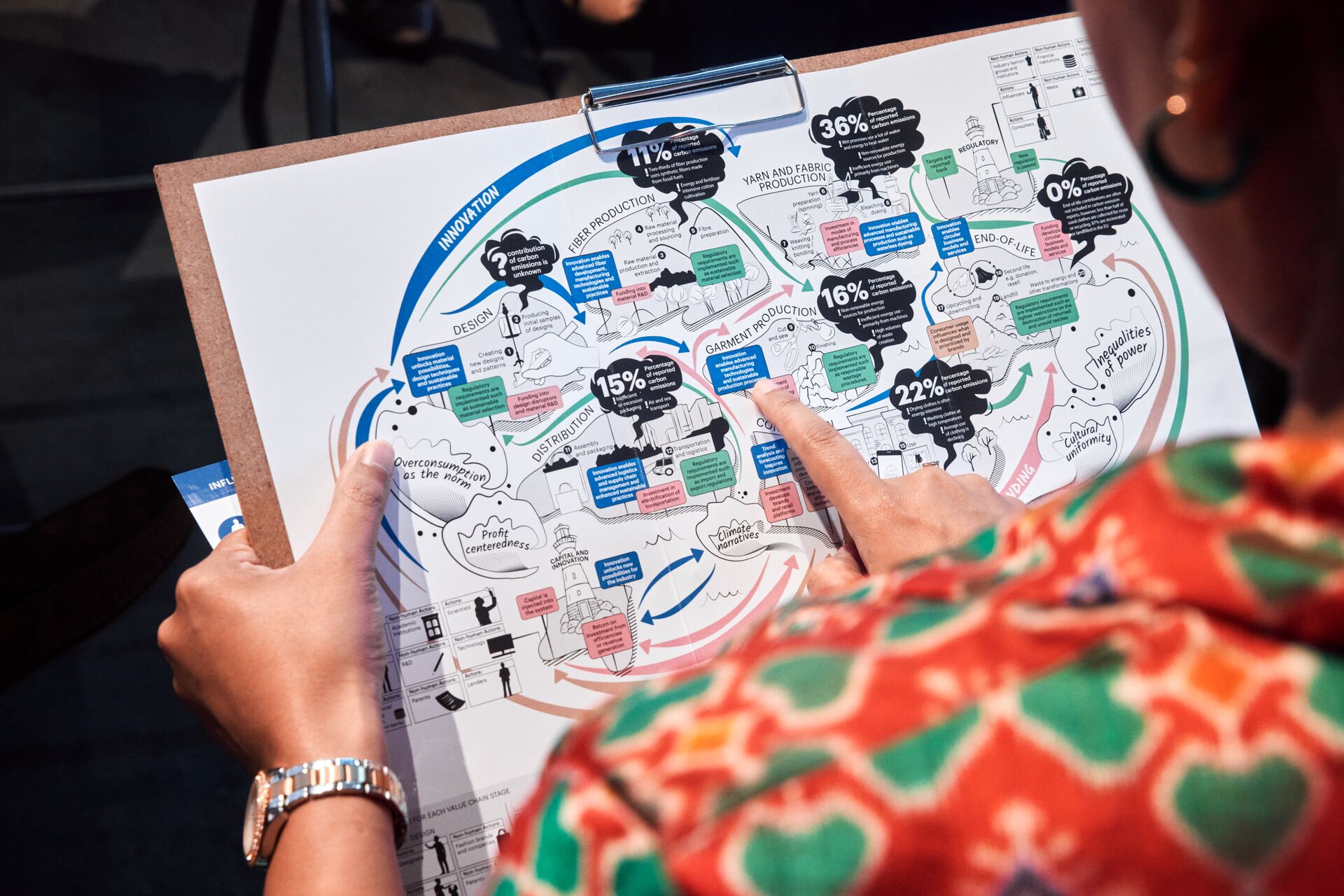
By mapping out the path to industry-wide decarbonisation, the System Map helps turn reflection into action, guiding the textile sector toward meaningful change. Now, we are making the map available to the entire industry – inviting actors across the value chain to explore their role…
Every shift towards sustainability reshapes the world we live in – but who gets a seat at the table, and who gets left behind? Fernanda Drumond, Head of Collective Action at the H&M Foundation, shares her insights and reflections about why a just transition is…
Imagine a future where Bangladesh’s textile industry not only thrives but also leads the way in sustainability and equity. A new report “Just Climate Transitions in Bangladesh”, authored by mission-driven consulting firm FSG and supported and co-funded by H&M Foundation and Laudes Foundation, reveals how…