Why promising textile solutions still struggle to scale
Over the past eight years, The Hong Kong Research Institute of Textiles and Apparel (HKRITA) and H&M Foundation have supported innovation in the textile industry. Together, more than 30 research projects have been developed, resulting in new technologies, materials and processes aimed at reducing the industry’s environmental impact.
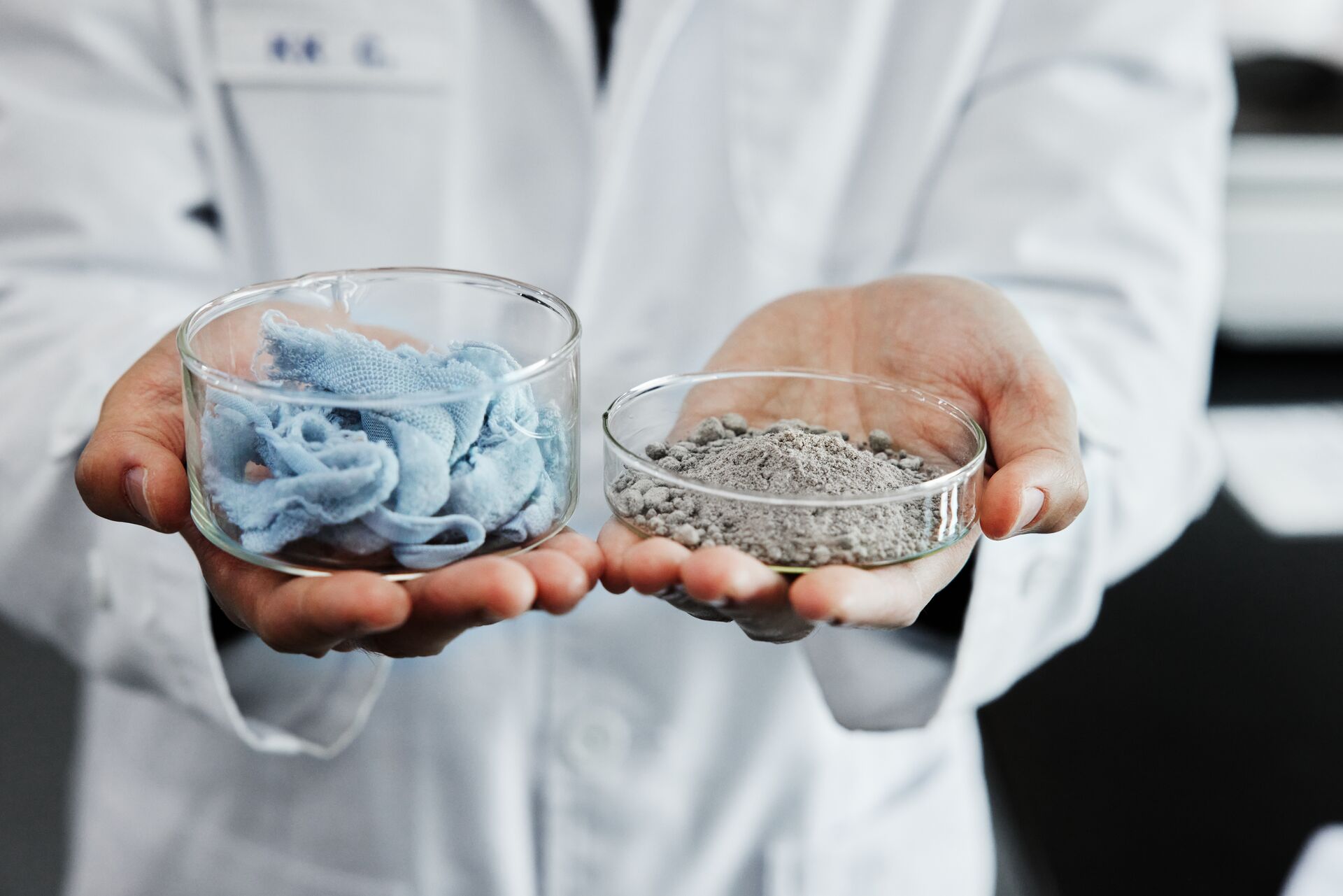
Test results from the Green Machine.
This work has contributed to scientific progress. It has also provided a better understanding of what it takes to move solutions from research into practice. One of the clearest lessons is that while generating new ideas remains important, the industry’s biggest challenge is creating the conditions for those ideas to be implemented at scale.
Below are three insights that stand out.
1. The reality of implementation
Our uniforms are used in operational environments, and their condition varies over time, requiring additional handling and pre-processing before recycling can even begin. This affects both efficiency and scalability.
That is how Annie Yeung, Manager of Sustainable Development at Hong Kong Aero Engine Services Limited (HAESL), describes the reality of working with HKRITA’s Green Machine – a technology that separates polyester and cotton in blended textiles, long considered one of the toughest problems in textile-to-textile recycling.
At HAESL, the barrier is not performance, but implementation. Once a solution is tested in real operations, new layers of complexity emerge: inconsistent materials, added handling, and the need to adapt existing processes. In practice, a functioning solution still needs to fit into day-to-day operations.
In contrast, technologies such as HKRITA’s nylon separation are seeing faster traction. Not necessarily because they are more advanced, but because they fit more easily into current production processes.
These examples show that even when a solution works, implementation brings new layers of complexity.
2. The business viability

Our pilot production has been very successful. We have already sold out our first small production run, and we have pre-orders for more.
This is how Windson Rao, Chairman of Fast Fish, a Chinese fashion company, describing the early response to products developed using HKRITA’s carbon capture technology, Carbon Looper.
“At the same time, this is a new material production process,” Rao adds. “We have encountered manufacturing issues in bulk production and are working with our fabric mill to execute this properly.”
The challenge, then, is not demand, but viability.
This is visible across the portfolio. For example, Absorboost, a cellulose-based material recovered through textile recycling and designed to improve absorbency in fibres, performs well technically, yet its application in textiles is limited by cost.
Together, these examples point to a simple but critical reality: for a solution to scale, it is not enough that it works – it also needs to make business sense.
3. The system conditions
Even when solutions can be implemented in real operations – and even when a business case begins to emerge – scaling depends on factors beyond any single technology or company.
Crystal International, one of the world’s largest apparel manufacturers and a long-term collaboration partner to HKRITA, views this as a matter of system readiness. By licensing HKRITA’s vertical hydroponic cotton technology and developing a demonstration unit in China, they highlight the need for stronger collaboration between industry, research and technology partners, as well as a willingness to engage earlier in the development and to think broadly about embedding sustainability across the textile value chain.
Acousweep, for example, is a technology that removes microplastics from water using sound waves. It can be integrated into existing systems, but wider adoption depends on how microplastics are measured and regulated, making it harder for the industry to act at scale.

Open Lab brings together brands, manufacturers and innovators to test and develop solutions in practice. It has attracted strong industry engagement, but moving from interest to implementation takes coordination and commitment across the value chain.
Scaling is not only about better solutions or stronger business cases – it is also shaped by the conditions around them. Standards, policies, incentives and collaboration determine whether a technology can move beyond pilots and deliver impact at scale.
What this means going forward
One of the clearest learnings from the partnership is that research and development remain essential. At the same time, R&D alone cannot drive adoption. It needs to be connected to real-world application through testing, collaboration and alignment with industry needs.
This is an area where HKRITA has evolved its role. Alongside developing technologies, there is now a stronger focus on how they can be applied and tested, including through platforms like Open Lab. This puts HKRITA in a better position to support the next phase of scaling these solutions.
That shift matters because the gap between invention and implementation is where many good ideas falter. This is also where research institutes can play a distinct role: not replacing industry, but helping reduce uncertainty, generate evidence and create the conditions for wider uptake.
For H&M Foundation, a similar shift is needed. Supporting innovation is not only about funding research, but about helping bridge the gap between development and implementation.
A shared responsibility
Scaling innovation is not the responsibility of a single actor. It requires continued research, but also engagement from across the industry, including manufacturers, brands, investors and policymakers.
The technologies already exist. The next step is to make them work within the realities of the industry. That means proving business cases, adapting processes, improving infrastructure, aligning incentives and building demand early enough for solutions to survive the journey from lab to market.
If you are interested in exploring these solutions or visiting Open Lab, HKRITA welcomes industry partners to get involved.
Press contact

Media Relations Responsible
In brief
H&M Foundation has supported HKRITA in developing and testing solutions to reduce the environmental impact of the textile industry.
Learn more about the Planet First programme.