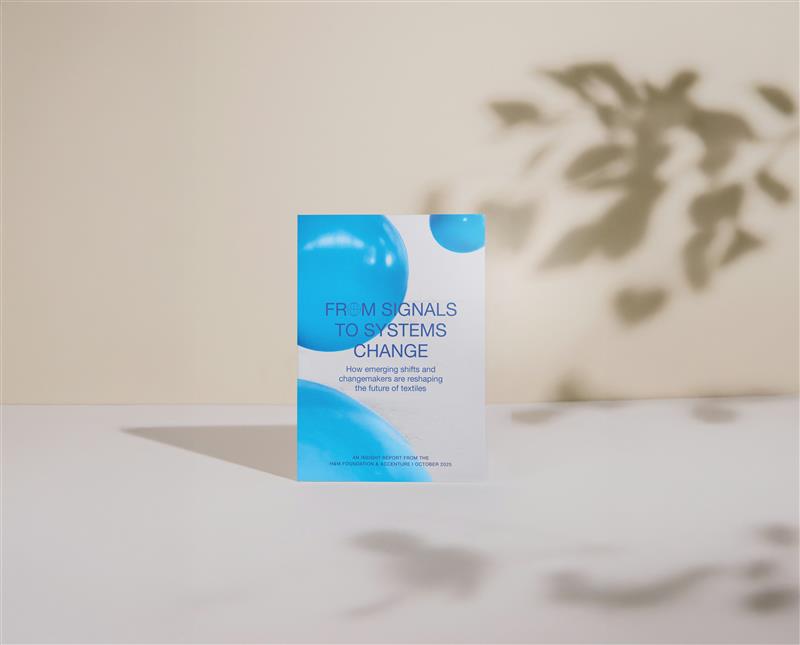
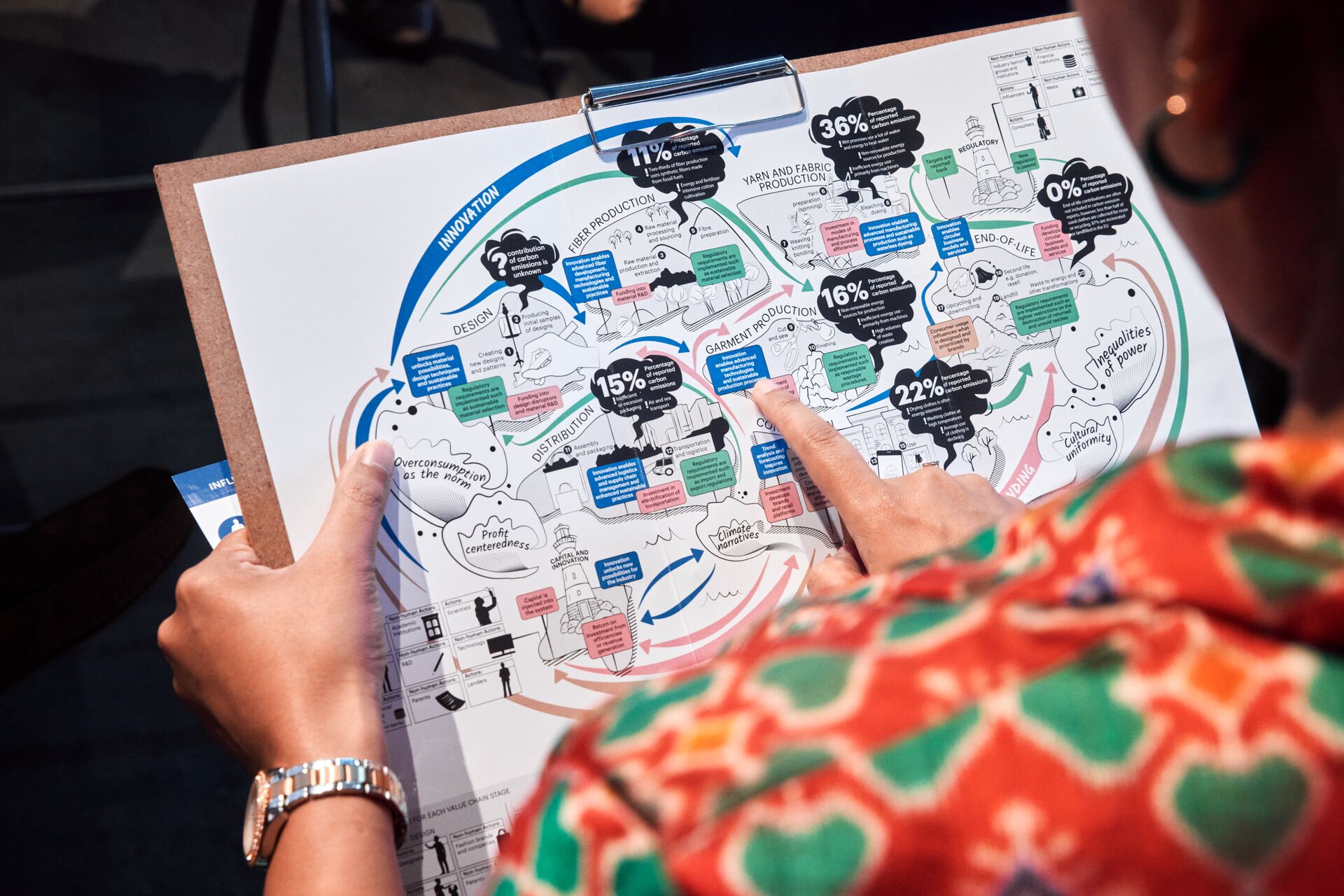
H&M Foundation, in collaboration with Accenture, has unveiled From Signals to Systems Change, an insight report calling on the fashion industry to rethink its role in transformation. At its core is the Reimagined System Map, a pioneering open-source framework that visualises how early-stage innovation could drive a just and net-zero textile future.
At the centre of the report is a reimagined system map, a tool that shows how today’s signals can evolve into industry-wide change. The report also models the potential impact of four GCA 2025 winners, revealing how small ideas, backed early, could save emissions, reduce water use and create new forms of work by 2050.
Grounded in insights from innovation, philanthropy and systems thinking, From Signals to Systems Change explores how early ideas can become a catalyst for a just and decarbonised textile future. It maps the key forces reshaping fashion, from AI and geopolitics to resource scarcity and biodiversity loss, and calls on industry leaders, investors and policymakers to recognise their place in an interconnected system.
If we don’t see the system, we can’t change it, and that’s exactly what this work helps us do.
Annie Lindmark, Programme Director Innovation, H&M Foundation
“By looking at the fashion system as it is today and reimagining what it could become, we visualised how scaling early-stage innovations might ripple across the industry“, says Annie Lindmark, Programme Director, Innovation at the H&M Foundation. Our hope is that different stakeholders will explore the System Map and ask themselves where in the system they have the most power to influence change, and in doing so, ignite new sparks of transformation.”
Annie Lindmark, Programme Director Innovation
A glimpse of a reimagined fashion system
To understand what early-stage innovation can achieve at scale, Accenture applied its 360-degree value approach to estimate the potential impact of four Global Change Award 2025 winners: Loom, PulpaTronics, Renasens and The Revival Circularity Lab. The findings show that small ideas, when supported early, can deliver outsized returns for both climate and communities. By 2050, their innovations could:
Save 570,000 tonnes of CO2 annually, equal to the life-cycle emissions of 170 million cotton T-shirts.
Save 160 billion litres of water, enough for the annual drinking needs of 200 million people.
Create 30,000 designer jobs and reduce 3,000 tonnes of e-waste each year.
Philanthropy as a catalyst for systems change
As an independent, privately funded philanthropic organisation, the H&M Foundation uses philanthropy as risk capital, funding early ideas, breakthrough research and collaborations often considered too early or too uncertain. Since 2015, its flagship initiative, the Global Change Award, has supported 56 teams from 23 countries with 10 million euros in grants, paving the way for circular and decarbonised business models across the textile value chain.
From Signals to Systems Change builds on that mission by showing how early-stage ideas could unlock systemic opportunities and accelerate transformation across the industry. When changemakers thrive, systems change follows. The report is part of the Foundation’s ongoing work to support the textile industry in halving its greenhouse gas emissions every decade while promoting a just transition for both people and planet.
An open invitation
The report closes with a challenge to every actor in the system, from brands and suppliers to investors and citizens:
Where in the system do you have the most power to influence change?
Who must you collaborate with to turn ideas into action?
What decision can you make today that signals real commitment to transformation?
From Signals to Systems Change is not just a report. It is an open invitation to imagine, collaborate and act. Explore the report here.
From Signals to Systems Change is an insight report calling on the fashion industry to rethink its role in transformation. The report maps key signals of change we are seeing in the textile industry and unveils the Reimagined System Map, a pioneering open-source framework that visualises how early-stage innovation could drive a just and net-zero textile future.
Each year, the Global Change Award backs early-stage innovations that could help transform the textile industry. The ten winners of 2025 are no exception. Selected for their bold and pioneering ideas, these changemakers are tackling some of fashion’s most urgent challenges: from reducing emissions and…
By mapping out the path to industry-wide decarbonisation, the System Map helps turn reflection into action, guiding the textile sector toward meaningful change. Now, we are making the map available to the entire industry – inviting actors across the value chain to explore their role…
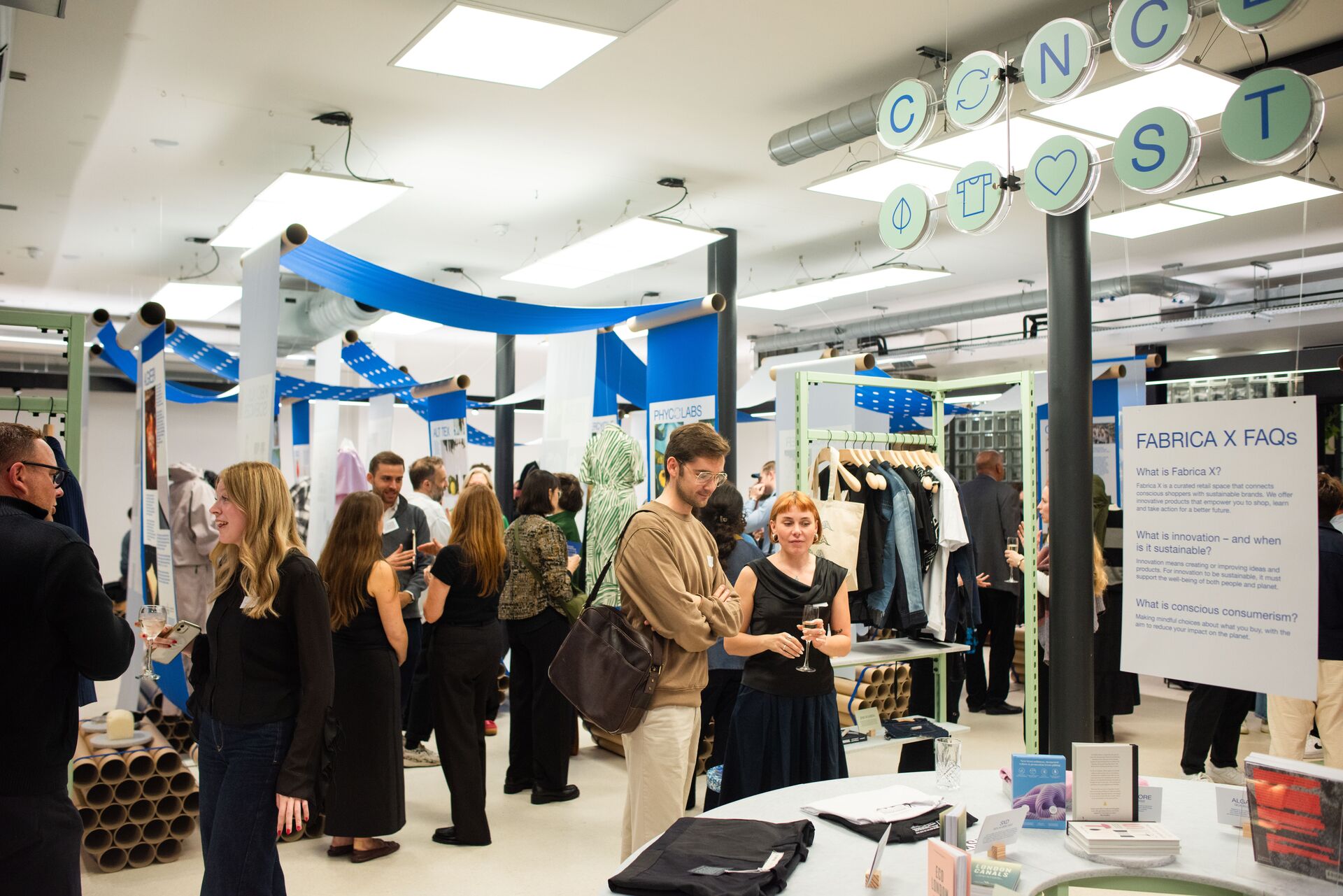
Celebrating 10 years of backing early-stage innovation, The Global Change Award Alumni Exhibition proves what’s possible when you believe in ideas long before they hit the mainstream. The Global Change Award Alumni Exhibition, co-created by the H&M Foundation and partner The Mills Fabrica, is taking place at Fabrica X…