System Map toolkit and guiding material
The textile industry must halve its greenhouse gas emissions every decade until 2050. This is not a marginal adjustment, it is a structural transformation. At the same time, decarbonisation must go hand in hand with a just transition.
Climate action cannot shift costs onto the most vulnerable parts of the value chain. It must consider who benefits, who bears the burden and who is meaningfully included in change.
Yet the fashion system is often approached through linear thinking and siloed action. One team optimises materials. Another improves logistics. Another sets targets. Important work happens, but often in isolation.
Linear thinking is not enough. To transform the system, we need a shared understanding of how it truly works: how incentives flow, where power sits, how decisions ripple across value chains and where meaningful leverage for change exists. Only when we see the system can we begin to reshape it.
What is the H&M Foundation System Map?
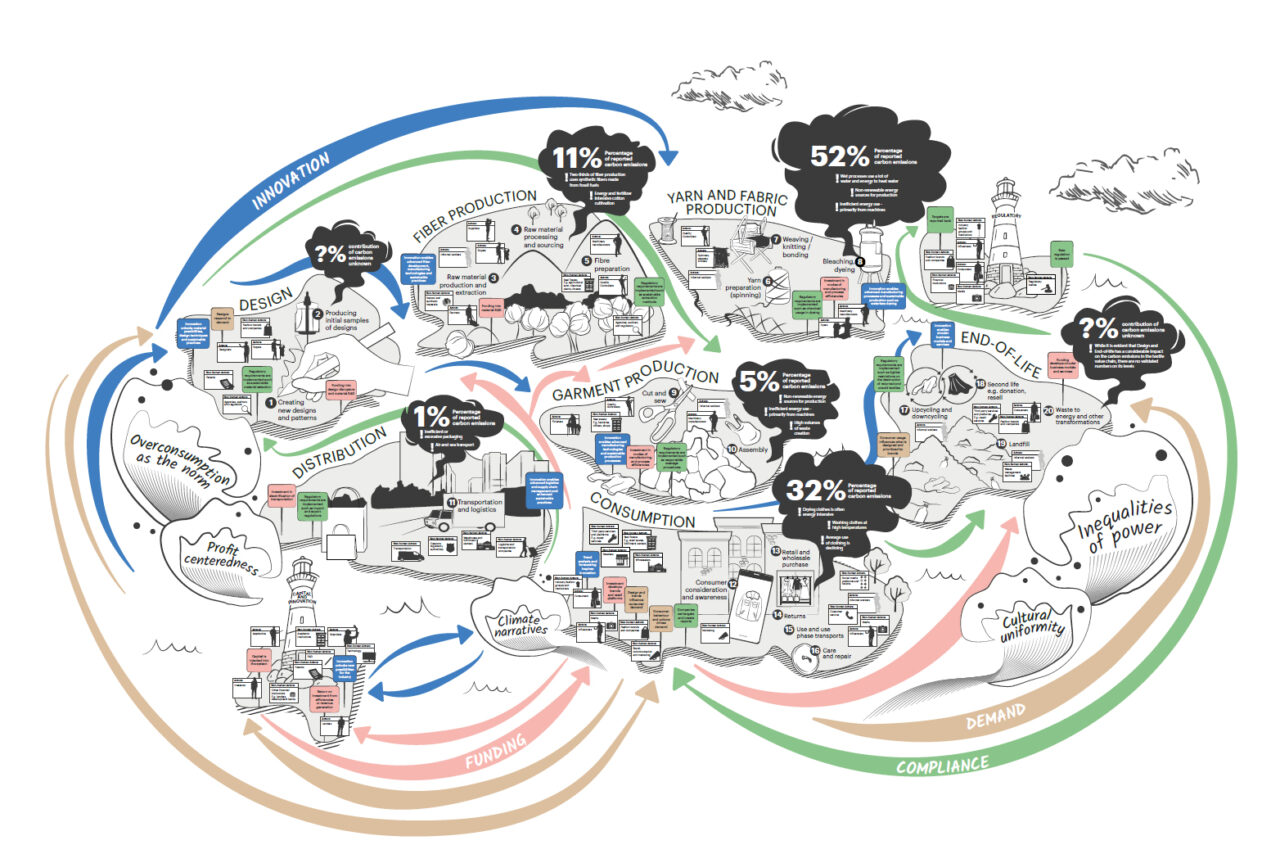
The System Map visualises the textile industry as an interconnected ecosystem, not a linear chain. Instead of presenting fashion as a straight line from design to end-of-life, the map reveals it as a network of islands, flows and forces connected through incentives, capital, innovation, regulation and demand.
The map is built on three layers:
- The value chain – The key stages of the textile system, from fibre production to consumption and end-of-life.
- Carbon emissions – Indicative emissions linked to different stages, highlighting hotspots and trade-offs.
- Systemic forces – Invisible but powerful forces such as profit-centredness, inequalities of power, cultural norms and climate narratives that shape how the system behaves.
Across these layers, the map also highlights:
- Actors – People, organisations and technologies shaping the system.
- Bus routes – The flows of complicance, capital, innovation and demand moving between islands.
- Leverage points – Moments where decisions, investments or policies can shift outcomes across the system.
Together, these elements can create a shared language for understanding complexity and a platform for informed action.
Why we created the System Map
We wanted to offer a shared, public tool for the industry. Today, sustainability efforts often struggle with unclear roles and fragmented responsibility. Many actors want to drive change, yet it is not always clear who influences what, where decisions sit, or how different parts of the system depend on each other. The System Map brings clarity. It highlights how brands, suppliers, policymakers, investors, civil society, researchers and innovators are connected and how their decisions shape outcomes across the value chain.
By making these relationships visible, the map supports collaboration and alignment. It helps different actors see where their influence lies and where coordinated action can unlock systemic change. Our ambition is to make systemic change tangible and usable. Not theoretical or abstract, but practical. The map is publicly available. It is meant to be used, adapted and built upon.
How to use the toolkit
To translate insight into practical use, H&M Foundation commissioned Accenture to develop a facilitation toolkit that enables organisations to apply the System Map in real-world settings.
The toolkit includes:
Systems map guide – A practical tool that explains how to read and use the System Map
Keynote presentation – An introduction to the System Map. How to read it, how to interpret its layers and how to use it as a shared starting point. (30 min)
Workshop 1 – Finding your role in the system – Participants identify where they sit on the map, visualising relationships and influence, and explore collaboration opportunities. (60 min)
Workshop 2 – Identifying impact opportunities – Participants examine systemic forces, recognise key leverage points and turn challenges into actionable opportunities. (90 min)
Workshop 3 – Reimagining the future system – Participants redesign the map to explore what a decarbonised and just textile system could look like, and define concrete steps to move towards it. (120 min)
Workshop format:
The toolkit can be used physically or digitally. Materials are designed to work as PowerPoint-based sessions, interactive digital workshops or printed, hands-on exercises.
For whom:
It is designed for brands, manufacturers, innovators, policymakers, investors, donors, researchers, civil society and industry newcomers. Whether you work inside the system or influence it from the outside, you are part of it.
Creating impact
The System Map creates impact by making complexity visible and actionable. It visualises how the textile industry operates as a connected ecosystem where decisions in one part of the system ripple across others. A material choice affects sourcing. A pricing decision influences working conditions. A regulatory shift reshapes investment flows. No action happens in isolation.
By revealing these connections, the map helps organisations:
• Identify leverage points where change can unlock system-wide shifts.
• Recognise power dynamics and structural barriers.
• Understand how one intervention may influence multiple parts of the value chain.
• Turn ambition into concrete, role-specific actions.
• Enable a just transition alongside decarbonisation
By using the map and toolkit, you gain:
• A shared understanding of how the system works and how its parts interact.
• Clarity on your role and sphere of influence.
• Concrete actions relevant to your organisation.
• A future-oriented vision of what a just, net-zero fashion system could look like.
When actors align around shared insight, small decisions can accumulate into structural change.
Download the toolkit
The System Map
System Map Guide
Keynote presentation
Workshop 1
Workshop 2
Workshop 3